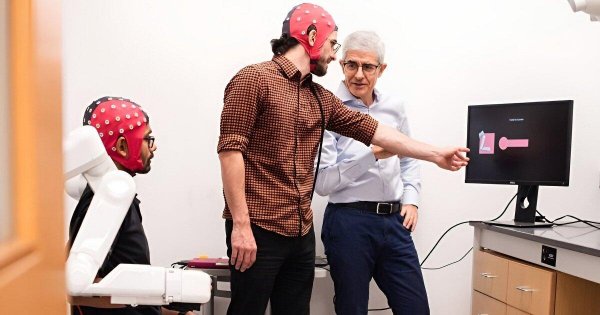
A wearable cap lined with electrodes is giving a new meaning to "hands-free" gaming, allowing users to steer video games with their thoughts alone. Developed by a team at the University of Texas at Austin, the device is a brain-computer interface (BCI) that requires no surgical implant and, according to a study published in the journal PNAS Nexus, can be adapted to a new user in a fraction of the time traditionally needed.
The cap, which is black and red with embedded brain-wave sensors, works by decoding neural signals through a machine-learning model. Unlike many existing BCIs that demand extensive per-user calibration or invasive procedures, this system was pre-trained on a single "expert" user who practiced a simple digital bar-balancing task. That training proved transferable: when the cap was tested on 18 "naive" subjects—people with no prior BCI experience—they learned to control both the bar game and a car-racing game within just five sessions. That's a marked contrast to conventional BCIs, which often require weeks or months of adjustment.
The research team, led by study author Satyam Kumar, emphasized the practical benefits. "When we think about this in a clinical setting, this technology will make it so we won't need a specialized team to do this calibration process, which is long and tedious," Kumar said in a statement. "It will be much faster to move from patient to patient."
The development comes amid growing interest in BCIs, from non-invasive headsets to brain implants like those from Neuralink. While implants have enabled paralyzed individuals to play games like Mario Kart, they carry risks from surgery and significant costs. The UT Austin cap aims to sidestep those hurdles, offering a more accessible entry point for assistive technology.
At the SXSW festival last month, the team demonstrated the cap's ease of use: several volunteers, with no prior training, learned to operate two hand-and-arm rehabilitation robots within minutes. That hands-on demo highlighted the potential for real-world application, though the researchers caution that the technology is not yet ready for commercial release.
Path to Wider Adoption
All 18 test subjects were healthy and without motor impairments, so the next critical step is to validate the device on individuals with disabilities—the population most likely to benefit from mind-controlled interfaces. Study co-author José del R. Millán, a neurology professor at UT Austin, underscored the mission: "The point of this technology is to help people, help them in their everyday lives. We'll continue down this path wherever it takes us in the pursuit of helping people."
The research represents a step toward more user-friendly BCI technology, though challenges remain. The team plans to expand testing to include people with motor impairments, which will be essential for clinical adoption. For now, the cap shows that mind-controlled gaming and assistive control are moving closer to practical, everyday use—no surgery required.