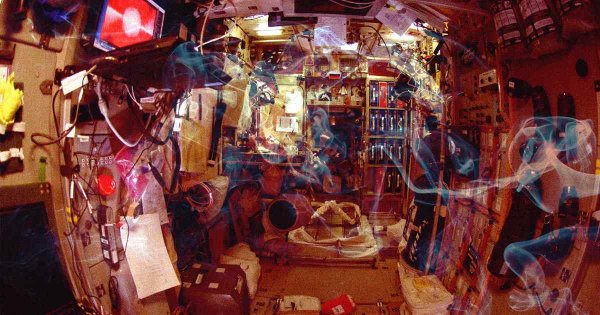
Early Thursday morning, smoke and fire alarms sounded in the Russian segment of the International Space Station, prompting crew members to investigate a burnt plastic odor, according to Russian state news agency RIA. The incident occurred in the Zvezda module, a key living area of the orbital outpost, and was first noticed around 5 a.m. Moscow time (10 p.m. Eastern) by European Space Agency astronaut Thomas Pesquet and cosmonaut Oleg Novitsky.
The crew activated air filters and reported the smell to ground control, but the exact source of the smoke remains unidentified. Roscosmos, the Russian space agency, later confirmed that the situation was contained and that all systems were functioning normally. The air composition on board was said to be within standard parameters, according to a statement translated by CBS News reporter William Harwood. The incident did not delay a scheduled spacewalk later that day.
While the crew was able to return to bed after the alert, the event has raised fresh concerns about the aging infrastructure of the ISS, which has been continuously inhabited for over two decades. The Zvezda module, launched in 2000, is a critical component for life support and living quarters, and it has shown signs of wear in recent years.
Just last week, Vladimir Solovyov, chief engineer of the Russian space company Energia, warned that parts of the ISS might be beyond repair. In comments to Russian state media, he suggested that once the station's in-flight systems are exhausted, irreparable failures could begin. He also noted the existence of superficial cracks and air leaks in the Zarya module, another Russian segment, which could spread over time. Both Roscosmos and NASA have maintained that crews were never in danger.
Why the Incident Matters
The timing of the smoke alarm is notable, given Russia's recent announcement of plans to leave the ISS by 2025 and establish its own separate space station. Russian state media has increasingly highlighted the station's deterioration, painting a picture of an outpost nearing the end of its operational life. Meanwhile, NASA is still negotiating with international partners on how to safely deorbit the station within the next decade.
Pesquet, who is active on Twitter, had not yet commented on the incident as of Thursday afternoon. The cause of the smoke remains under investigation, and it is unclear when a definitive explanation will be provided. The incident adds to a series of minor anomalies that have occurred as the ISS enters its 22nd year of continuous operations, underscoring the challenges of maintaining a complex orbital laboratory.
For now, the crew is safe and the station continues to operate, but the event serves as a reminder of the inherent risks of human spaceflight and the importance of robust safety systems. As the ISS ages, such incidents are likely to become more frequent, raising questions about the timeline for its eventual retirement and the transition to new space stations.