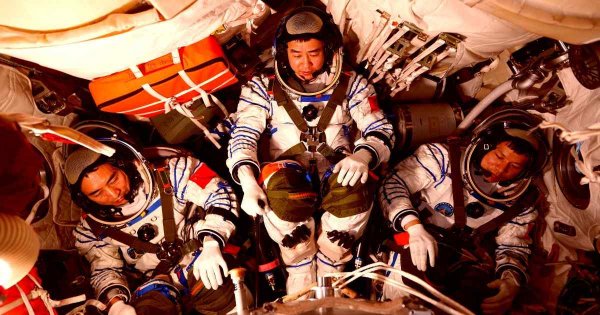
Three Chinese astronauts returned to Earth early Thursday morning, but not aboard the spacecraft they had expected. The China Manned Space Agency (CMSA) confirmed that the Shenzhou-20 capsule, which had been docked at the Tiangong space station since April, sustained tiny cracks in its viewport window—likely from a space debris impact—forcing a change in return plans.
The discovery was made earlier this month, prompting the CMSA to postpone the November 5 return. In a statement to the state-run Xinhua news agency, the agency said the cracks were “most probably caused by external impact from space debris” and that the spacecraft “does not meet the requirements for the astronauts’ safe return.” Instead, the Shenzhou-20 will remain in orbit to continue experiments, while the crew returned aboard the newly arrived Shenzhou-21, which launched October 31 with three replacement astronauts.
The safe landing in Inner Mongolia closed a tense chapter, but the incident has cast a spotlight on the escalating hazard of orbital debris. Space junk—ranging from defunct satellites and spent rocket stages to fragments as small as a millimeter—travels at speeds of tens of thousands of miles per hour. At such velocities, even a tiny fleck can strike with the energy of a bullet, capable of damaging spacecraft hulls, windows, and critical systems.
“It’s somewhat ironic that China’s spacecraft took a hit from space junk,” said Lincoln Hines, assistant professor of international affairs at the Georgia Institute of Technology, in a commentary for The Conversation. He noted that China has historically been a major contributor to the debris problem. In 2007, the country deliberately destroyed its defunct Fengyun-1c weather satellite in an anti-satellite weapon test, generating more than 3,000 pieces of trackable debris that remain in orbit today.
Why Orbital Debris Is a Growing Concern
The Shenzhou-20 incident is not isolated. The International Space Station and other crewed outposts regularly fire thrusters to dodge debris, a practice that has become routine as the population of satellites and junk grows. Experts warn that without active cleanup or stricter mitigation measures, the situation could worsen, especially as commercial megaconstellations and military anti-satellite tests add to the clutter.
The CMSA has not announced a specific timeline for the next crewed mission, Shenzhou-22, stating only that it “will be launched at an appropriate time in the future,” according to Xinhua. Meanwhile, the damaged Shenzhou-20 remains attached to Tiangong, where it will be used for further research before its eventual disposal.
For the three returning astronauts, the ordeal ended safely, but the event serves as a reminder that the orbital environment is becoming increasingly crowded and hazardous. As human activity in space expands, the risk of such impacts—and the need for robust shielding and contingency plans—will only intensify.