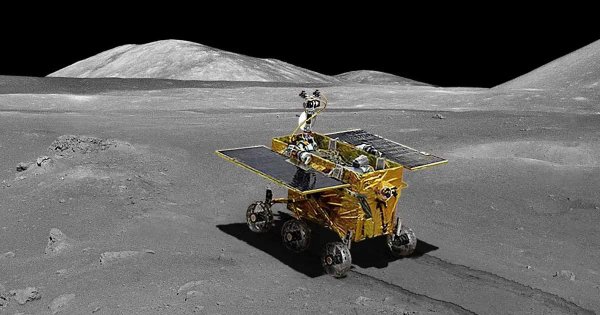
China's Yutu-2 lunar rover has uncovered a surprising characteristic of the Moon's far side: the soil there is stickier than the soil on the side facing Earth. The discovery, detailed in a paper published this week in the journal Science Robotics, adds a new wrinkle to our understanding of the Moon's surface.
The finding emerged after mission scientists noticed that clumps of lunar soil kept adhering to the rover's wheels as it traversed the far side. The team concluded that the regolith—the loose soil and rock covering the lunar surface—on the far side behaves similarly to dry sand and sandy loam found on Earth, according to the paper.
The far side of the Moon, which permanently faces away from Earth, has long been a subject of curiosity. Yutu-2, part of China's Chang'e-4 mission, made history in 2019 as the first rover to explore this region. The new data provides a rare close-up look at the soil composition there.
Crater Count and Volcanic History
In addition to the sticky soil, the study reported data from 88 craters observed by Yutu-2. Of those, 57 are less than 33 feet in diameter, while two measure roughly 200 feet across. The far side appears to have significantly more craters than the near side, a difference the researchers attribute to several factors.
Earth's gravitational pull helps shield the near side from some meteoroid impacts, while the far side is more exposed. Additionally, the near side has experienced more volcanic activity in its past, which filled in and erased many craters. Evidence from China's Chang'e-5 mission, which returned lunar samples in 2020, indicated volcanic activity on the near side as recently as two billion years ago—geologically recent, though still ancient by human standards.
The findings underscore that the Moon still holds surprises, even after decades of exploration. The data from Yutu-2 not only helps scientists understand the Moon's evolution but also informs planning for future missions, including NASA's Artemis program, which aims to return astronauts to the lunar surface.
While the sticky soil might seem a minor detail, it has practical implications for rover mobility and future human exploration. Understanding the physical properties of the regolith is crucial for designing equipment and habitats that can withstand the lunar environment.